Sage Intacct is a cloud-based financial management platform built for organisations that have outgrown basic accounting software. It automates core finance processes, consolidates multiple entities and currencies in real time, and gives finance teams a single, audit-ready source of financial truth instead of a patchwork of spreadsheets.
This guide explains what Sage Intacct actually does, who it’s designed for, how it differs from entry-level tools like QuickBooks or Sage 50, and what determines its cost. It’s the starting point for the rest of this series, where we go deeper into UAE-specific considerations, pricing, features, AI capabilities, and how Sage Intacct compares to its main alternatives.
What Is Sage Intacct?
Sage Intacct is a cloud financial management and accounting platform owned by Sage Group plc. It’s built around a core general ledger, accounts payable, accounts receivable, and cash management, then extended with multi-entity consolidation, project accounting, and dimensional reporting.
The platform is native to the cloud. It wasn’t a desktop product that was later hosted online, which matters for how it handles updates, uptime, and remote access. Finance teams work from a browser, data updates in real time, and new features roll out automatically through quarterly releases rather than manual upgrades.
Sage Intacct is also the American Institute of CPAs’ (AICPA) preferred provider of cloud financial applications, delivered through the AICPA’s business and technology arm, CPA.com. It remains the only accounting platform to hold this endorsement, which is one reason it’s widely used by CPA firms, professional services businesses, and finance-led organisations globally.
What Does Sage Intacct Actually Do?
At its core, Sage Intacct automates the accounting work that eats up a finance team’s time and replaces manual reconciliation with structured, auditable workflows. The main functional areas are:
- Core accounting. General ledger, accounts payable, accounts receivable, cash and bank reconciliation, with a full audit trail.
- Multi-entity and multi-currency management. Consolidate financial data across subsidiaries, branches, or group companies, with automated currency conversion and intercompany eliminations.
- Dimensional reporting. Instead of building a long, rigid chart of accounts, Sage Intacct tags each transaction with dimensions such as department, location, project, or customer. This lets finance teams slice a P&L by project or location without recoding the chart of accounts.
- Financial planning and budgeting. Compare budget to actual spend in real time and adjust forecasts as conditions change.
- AI-assisted finance workflows. A set of built-in AI agents that support close, accounts payable, and financial reporting (covered in detail elsewhere in this series).
The result is fewer manual journal entries, a faster month-end close, and real-time visibility that doesn’t depend on someone exporting data into a spreadsheet.
Is Sage Intacct an ERP or Accounting Software?
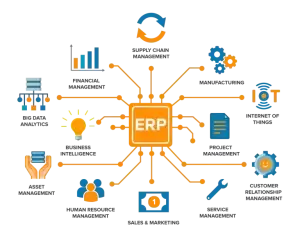
Sage Intacct is commonly described as cloud financial software, but whether that also makes it an ERP depends on how strictly “ERP” is defined. Sage Intacct meets the core definition of an ERP: a single, integrated system of record running general ledger, accounts payable, accounts receivable, cash management, purchasing, and project accounting on one shared database.
Where it differs from a broad ERP like SAP or Oracle is emphasis. Sage Intacct is finance-first. Its depth sits in accounting, multi-entity consolidation, and reporting, not in shop-floor manufacturing or warehouse management. For service-led, subscription-based, or multi-entity organisations, it functions as a complete financial ERP. Businesses that manufacture or distribute physical goods at scale typically extend it through the Sage Intacct Marketplace or look at a broader platform.
We cover this distinction in more depth, including where Sage Intacct’s ERP capabilities stop, in the dedicated article on Sage Intacct and ERP classification later in this series.
Who Is Sage Intacct Built For?
Sage Intacct is designed for growing and mid-sized organisations, not startups running a single-entity, single-currency ledger. Sage’s own guidance for its global/US market points to businesses with more than 20 employees or upwards of $4 million in annual revenue as a typical fit. Sage hasn’t published a separate benchmark for the UAE specifically, so treat this as a general indicator of scale rather than a strict cutoff. In practice, operational complexity is the more useful signal than headcount or revenue alone.
Common triggers for moving to Sage Intacct include:
| Signal | Why it matters |
| Multiple entities, branches or free zone structures | Manual consolidation becomes slow and error-prone |
| Multi-currency transactions | Spreadsheet-based FX handling introduces risk |
| Month-end close taking too long | Automation and workflow controls shorten the cycle |
| Growing team, still on desktop or entry-level software | Real-time, cloud-based collaboration replaces file-sharing |
| Board or investor demand for real-time reporting | Dashboards remove the wait for manual reports |
It’s used across professional services, financial services, SaaS and subscription businesses, healthcare, hospitality, nonprofits, and trading and distribution companies. Rockford Computer supports growing UAE businesses across several of these sectors with Sage Intacct implementation and support services tailored to multi-entity structures.
Sage Intacct vs Entry-Level Accounting Software
The most common comparison finance leaders make is Sage Intacct against the tools they’re already using: Sage 50, QuickBooks, or similar desktop or entry-level cloud accounting software. The short answer is that Sage Intacct is built for complexity that those tools weren’t designed to handle.
| Entry-level accounting software | Sage Intacct | |
| Deployment | Desktop or basic cloud | Native cloud |
| Multi-entity consolidation | Manual or unsupported | Built in, automated |
| Multi-currency | Limited | Native support |
| Reporting | Fixed or export-based | Real-time, multi-dimensional |
| Audit trail | Basic | Detailed, built for compliance |
| Customisation | Minimal | Configurable workflows and dimensions |
| Typical user | Small business, single entity | Growing or mid-sized, multi-entity |
Businesses usually make the switch when reporting delays, reconciliation errors, or a lack of visibility across entities start slowing down decisions rather than just being an inconvenience.
What Determines the Cost of Sage Intacct?
Sage does not publish a fixed, one-size-fits-all price list for Sage Intacct, in the UAE or globally. Pricing is quote-based and depends on a combination of:
- Number of users, split between full (“business”) users and limited-access users.
- Modules activated, since core financials, order management, project accounting, and planning are priced separately.
- Number of legal entities being consolidated.
- Implementation scope, including data migration, configuration, and training.
Because of this, any figure quoted online for a different market shouldn’t be treated as a UAE price. The only reliable way to get an accurate number is a scoped quote from Sage or a certified implementation partner, based on your actual user count, entity structure, and module requirements. We break this down in full detail, including how to prepare for that conversation, in the dedicated Sage Intacct pricing article in this series.
AI Capabilities in Sage Intacct
Recent releases have added a set of AI-powered agents built into the platform, aimed at reducing manual finance work rather than replacing finance judgement. These include agents that support the month-end close, flag unusual journal entries for review, assist with accounts payable matching, and answer plain-language questions about financial data through Sage Copilot.
Availability and rollout of specific AI features can vary by release phase and contract, so it’s worth confirming current availability with a partner rather than assuming every capability is live for every customer. We go into each AI feature, and what’s confirmed for general availability versus phased rollout, in the AI-focused article later in this series.
Sage Intacct in the UAE
Sage Intacct is available to UAE businesses, typically through certified regional implementation partners rather than direct self-service signup. For UAE-based finance teams managing free zone entities, multi-currency trading, or group structures across the GCC, the multi-entity consolidation and dimensional reporting are usually the biggest draw.
UAE-specific considerations, including VAT handling, local compliance, and what a typical UAE implementation looks like, shape how Sage Intacct works for UAE businesses day to day, and we unpack each of those in detail next.
Getting Started
If your finance team is spending more time reconciling entities in spreadsheets than analysing performance, that’s usually the clearest sign Sage Intacct is worth evaluating. The next steps are understanding which Sage Intacct features matter most for your structure, and getting a scoped quote based on your actual user count and modules rather than a generic online estimate.
What People Ask About Sage Intacct
What problems does Sage Intacct actually solve for a finance team?
The core problems are slow month-end closes, fragmented data across entities, and manual reconciliation eating up time that should go toward analysis. Sage Intacct addresses these by automating routine transaction processing and consolidating multi-entity data in real time, so finance teams work from one current data set instead of stitching together exports.
Is Sage Intacct classified as an ERP, or is it accounting software?
It sits in between, and leans ERP. It runs general ledger, AP, AR, purchasing, and project accounting on one integrated database, which meets the core definition of an ERP. It doesn’t extend into manufacturing or warehouse operations the way a full-suite ERP does, which is why it’s best described as a finance-first ERP rather than a general-purpose one.
What size or type of business is Sage Intacct actually built for?
It’s built for organisations that have outgrown single-entity, spreadsheet-based accounting, not for early-stage startups. The clearest signals are operational complexity: multiple entities, multiple currencies, or a board that expects real-time reporting rather than a monthly export.
Why doesn’t Sage Intacct publish a fixed price?
Because cost depends on variables that differ by customer: how many users need full access versus limited access, which modules are activated, and how many entities are being consolidated. A quote-based model lets pricing reflect actual usage instead of forcing every customer into the same tier.
What makes Sage Intacct’s cloud architecture different from software that’s simply hosted online?
Sage Intacct was built for the cloud from the start, rather than taken from a desktop product and rehosted on a server. That distinction affects how updates are delivered (automatic, quarterly, no manual installs), how data stays current across users, and how the system scales without requiring a version upgrade project.
In practical terms, how does Sage Intacct compare to Sage 50 or QuickBooks?
The gap shows up once a business has more than one entity or currency to manage. Sage 50 and QuickBooks are built around a single, self-contained ledger. Sage Intacct is built around configurable workflows and an audit trail designed for multi-entity oversight, which is why finance teams tend to move to it when reconciliation and consolidation become the bottleneck rather than the accounting itself.