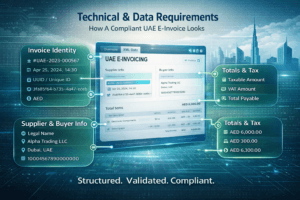
The UAE’s Peppol-Based DCTCE 5 Corner E-Invoicing model is a decentralised e‑invoicing framework where UAE e-invoicing data moves between suppliers and buyers through accredited intermediaries, while also being reported to the UAE tax authority. For businesses preparing for e-invoicing in the UAE, understanding these “five corners” is the fastest way to grasp how compliance, transmission, and interoperability will work in practice.
What is the UAE Peppol DCTCE 5-Corner E-Invoicing Model?
The UAE has adopted a Decentralised Continuous Transaction Control and Exchange approach, commonly referenced as ‘DCTCE’, implemented through a Peppol “5‑corner” network design. In simple terms, invoices are exchanged business‑to‑business through a Peppol‑style network of certified service providers, while the government platform receives invoice data for oversight and compliance.
The term 5-corner describes this model as comprising five distinct e-invoice participants along the process: supplier, supplier access point/service provider, buyer, buyer access point/service provider and UAE Authority Platform.
Accordingly, this method will be used as a foundation for the implementation of the UAE EIS and will be scalable across the various business-to-business and business-to-government e-invoices of the UAE.
Why the UAE chose a Peppol‑based approach
Peppol is a method of exchange for structured electronic business documents (invoices) in order to promote consistency and compatibility across different ERP systems and industry types within the UAE. Therefore, many recent updates on the development of Peppol e-invoicing in the UAE highlight UAE Peppol e-invoicing and Peppol’s technical basis (the language) as the underlying logic of the network and programme.
In the business environment, Peppol promotes the establishment of a standard way of managing data quality (through the use of standardised schemas and validation rules) and minimises the need to create custom integrations between suppliers/buyers, decreasing the need for developing a custom integration to every supplier and buyer as part of the exchange (bilaterally).
In addition, Peppol allows for a decentralised model where off-the-shelf solutions can also be offered from authorities who may not provide the complete service of receiving reports or invoices; therefore, this allows the authorities to monitor and receive completed invoices without being the single point through which all invoices must pass to complete the process of being exchanged for business purposes.
The “Five Corners” Explained (Who does What)
Corner 1: Supplier (Invoice Issuer)
This corner of the relationship creates the invoice for the supplier through an ERP/accounting system based upon sales, taxes and other information required to create a proper invoice. This is where e-Invoicing ERP integration also plays an important role because invoice data must be both structured in a manner that can be validated and sent to the purchaser.
Corner 2: Supplier’s Access Point / Service Provider
The supplier connects to the e-network via the supplier’s access point (or “access provider” as it is often referred to in the Peppol language), which acts as an intermediary to allow the supplier to validate invoice data and transmit it to its purchaser. In the UAE, service providers for e-invoicing closely correspond to the concept of service provider accreditation prescribed within the UAE e-invoicing framework.
Corner 3: Buyer (Invoice Recipient)
Through the first two corners of this relationship, the buyer receives validated invoice information as structured data and not simply as a PDF or other image file. The use of structured invoice data allows the buyer to quickly record, match and store invoices in their financial systems. Therefore, an important benefit is that invoice capture becomes more automated, thereby reducing chances for human error in the process.
Corner 4: Buyer’s Access Point / Service Provider
For buyers who do business with many different suppliers, the buyer’s access point receives the invoice through the e-network and then delivers the invoice information to the buyer’s financial systems in a consistent manner. Having a consistent invoice information channel across vendors simplifies invoice processing for buyers.
Corner 5: UAE Authority Platform
This user platform serves as the government side of the model for reporting invoice data for compliance purposes. The industry description of this user platform suggests that it mostly serves as an archive and oversight function instead of being the validating function for each individual invoice throughout the business exchange process.
How an invoice flows end‑to‑end in the DCTCE model
The process of e-invoicing in the UAE using the 5-corner model generally follows these steps:
- Invoicing data is generated and created in the supplier’s billing/ ERP System and formatted/ prepared for structured transmission.
- The Supplier’s Service Partner (any Access Point/ASP) will validate (check) the invoicing data and convert this to the UAE standard syntax (this process is referred to in Implementation Guidance as PINT AE XML).
- The Invoicing data will then be transmitted over the Peppol-style network to the Buyer’s Service Partner, where it will be transmitted to the Buyer in a structured format.
- At the same time (or as one mailing as specified in Implementation Guidance), the invoicing Data will be reported to the UAE Authority Platform as the 5th Corner for the purpose of auditor oversight.
The rationale for this design is to demonstrate why Implementation Planning must include both “Business Exchange Readiness” as well as “Reporting to the Authorities.” Additionally, this demonstrates the importance of choosing the right e-Invoicing ASP partner when the time comes to implement your e-invoicing initiative. The APS represents your ideal invoicing highway.
PINT AE, UBL, XML/JSON: What Formats Actually Matter?
To be recognized and accepted as lawful e-invoices in the UAE, the e-invoices must be machine-readable and meet requirements for compliance according to several standardised formats. Examples of these formats include the PINT AE (Arab Emirates e-Invoicing) XML and JSON, UBL and Peppol (the new European standard) standards established in a marketplace, etc. In discussions with various suppliers, references have been made to supporting e-invoice formats of structured XML or JSONs. Typically, these types of invoicing can reference the EDI model of UBL (UBL is the Global Localisation Initiative for Documents) and the localised version of Peppol PINT.
To better understand the different types of electronic invoice formats, it is helpful to think about them from a more practical perspective:
- Your ERP may generate e-Invoices internally as structured UBL 2.1 XML or JSON files.
- Typically, your ASP (Application Service Provider)/access point will take that generated invoice, perform a validation process and modify the format of the e-Invoice to meet the requirements of the UAE and convert it for network transmission and reporting.
This is why many e-Invoice compliance documents specify that PDF invoices are “not true e-Invoices” under a CTC/Peppol framework, where the recognised compliant e-Invoice is the structured message.
What changes for Businesses: Compliance, Controls, and Data Quality
The most significant change in e-invoicing compliance within the UAE is that invoice quality is now seen as a system-wide process rather than just as a function performed within the finance back-office. Also, since invoices must go through validation checks and structured validations, any issues with master data (TRN, address, amount of VAT, and item tax category) will now be blocking items rather than being found in the clean-up process at the end of the month.
Finally, there will be a change in how e-invoices are stored within the UAE and how e-invoices can be retrieved. Since e-invoice data forms part of the regulated digital trail, e-invoice storage must now retain the structure necessary for retrieval. Furthermore, businesses will have to prepare for further auditability. This is due to increased structured invoice messages being available, which will allow authorities to analyse transaction behaviour more easily.
What to do Now: Implementation Checklist Aligned to the 5‑Corner Model
The implementation of UAE’s electronic invoicing system in 2026-2027 depends on five major components. The components are:
- Determine Scope: What are the flows for both UAE B2B & UAE B2G Electronic Invoicing (EI) and who are the first entities to be compliant?
- Decide Intermediary: Identify what are the FTA-accredited electronic invoicing providers or accredited service providers (ASP). Identify which suppliers are accredited and can support PEPPOL connectivity.
- Preparing the Systems: Start by prioritising the UAE e-invoicing ERP integration and then the Data Mapping to the appropriate standards (PINT AE & UBL). Design an API integration that provides a stable connection to the UAE EI portal.
- Begin Testing: Create a plan to test early, even if the product is still being developed and release it in stages or pilot tests. Develop structured test cases for Invoices, Credit Notes, Cancellations and other unusual Practise VAT scenarios.
- Establish Governance: Create a checklist to track your organisation’s readiness for UAE EI. This includes but is not limited to Master Data Ownership, Exception Workflow Procedures, Archiving and Compliance Monitoring.
The ultimate objective of this process is to provide the Finance and IT departments with an opportunity to work as a single unit, rather than two separate departments.
Conclusion
The introduction of the “5-Corner” model for e-invoicing in the UAE is a complete change in the way e-invoicing is performed in the UAE, from being purely compliance-driven to being a fully interoperable and integrated network. With the addition of accredited service providers serving as intermediaries with invoice flows, the “5-Corner” framework provides control over the source of the e-invoice until it is received by the end-user. The model provides businesses with the tools to implement their e-invoicing processes from the generation of the e-invoice XML format to storing the e-invoices in the UAE. Businesses that understand how to utilise the five corners (the supplier, the supplier’s ASP, the buyer, the buyer’s ASP, and the authority) will be able to develop their implementation guide for UAE e-invoicing in a structured manner.
Businesses that take action now on UAE e-invoicing API integration, following the latest UAE standards for Joint Electronic Data Interchange, and participate in the AEDU e-invoicing sandbox, will place their businesses ahead of the upcoming February 2026 & February 2027 implementation deadlines, avoid penalties associated with UAE e-invoicing, and be able to benefit from faster cash cycles and fewer disputes brought on by e-invoicing in the UAE.
The UAE e-invoicing model is a benchmark in the region for both scalability and future-proof compliance to facilitate both regulatory compliance and operational excellence as the country advances its e-invoicing digital tax model (DTD).
Frequently Asked Questions (FAQs)
- What is the UAE DCTCE 5-corner model in e-invoicing?
The DCTCE 5-corner model of the UAE is an e-invoicing method that establishes a direct communication flow among a supplier (the vendor), the vendor’s ASP (automated service provider), the customer (the buyer), the buyer’s ASP, and the FTA (the Federal Tax Authority) in connection with the issuance of structured invoices and the ongoing monitoring of compliance with regulations.
- How does Peppol work in UAE e-invoicing?
The Peppol platform acts as a standard operating procedure to facilitate the transfer of UAE e-invoices in XML format and JSON format through certified access points between any two or more parties who are utilising a Peppol-enabled interface. As a result, through the establishment of certified access points, company ERPs are able to operate without custom integration points between one another.
- What role does the accredited service provider ASP UAE play?
The accredited service provider (ASP) assists its clients to meet all requirements of e-invoicing to the FTA (the Federal Tax Authority) in the UAE by validating and signing invoices prior to transmitting them through the Peppol network. The ASP also provides a secure environment to store the invoices they transmit to the Peppol network after ensuring that the invoices they are sending to the FTA meet the compliance requirements established by the UAE.
- Which formats are used in UAE’s 5-corner model?
All invoices transmitted through the Peppol (DCTCE) 5-corner model must comply with UAE e-invoicing regulations and standards by using the pint.ae UBL UAE structure in either XML format or JSON format, as defined by the Technical Specifications of the UAE e-Invoicing Initiative and have to be validated by an ASP prior to transmission through the Peppol network.
- How does the 5-corner model improve UAE e-invoicing compliance?
In addition to providing assurance of data quality through validation gates, the 5-corner model enhances accountability through continuous transaction control since all transactions must have been validated at the conclusion of each step of the flow of e-Invoices to the FTA; it facilitates the integration of ERPs of UAE businesses and allows for automation of processes via B2B/B2G flows.