When HR managers evaluate an HRMS, two questions usually surface early: what can it do, and how is it put together? The first question is about features. The second is about modules, and the two are not the same thing. A feature is a specific capability. A module is the structural unit that houses a group of related capabilities, determines how they connect to each other, and in some cases governs how the system is licensed or implemented. Understanding how the Sage 300 People system is organised into modules matters because it shapes how a business deploys it, which teams interact with which parts, and how deeply the platform can grow with the organisation over time.
What Modules Are Included in Sage 300 People?
Sage 300 People is built around several core modules, each covering a distinct area of HR and payroll operations. Rather than a single monolithic system where everything sits in one undifferentiated block, the platform separates functions into structured modules so that HR teams, payroll teams, and management interact with the parts of the system relevant to their role.
The main modules are:
HR Administration Module
This is the foundation of the system. It holds the employee master record, which is the single source of truth that all other modules draw from. Employment history, contract terms, personal details, visa and labour card information, department and reporting line data, and document storage all sit here. When anything changes in an employee’s record, whether a salary revision, a department transfer, or a visa renewal, it updates here first and flows through to payroll, leave, and reporting automatically.
For UAE businesses, the Sage 300 HR administration module is particularly important for tracking labour card and Emirates ID expiry dates, which carry compliance implications if they lapse unnoticed. Rather than relying on a calendar reminder or a shared spreadsheet to flag upcoming renewals, the system surfaces these against the employee record directly.
Payroll Module
The payroll module is the calculation engine of the system, but it doesn’t operate from its own data. It reads the employee record from HR administration and approved leave data from the leave management module to produce each payroll run. This dependency is intentional: the payroll module’s accuracy is only as good as the records feeding into it, which is why maintaining the HR administration module correctly matters as much as configuring payroll rules. For more detail on what this means in practice for UAE payroll teams, this guide to Sage 300 People payroll covers the specifics.
What the module structure adds here is auditability: every payroll run is logged against the employee record and the specific policy rules applied at that time, which matters when a gratuity calculation from three years ago needs to be traced or verified.
Leave Management Module
The Leave Management module maintains employee leave records and policies. It relies on HR Administration for employee contract terms and entitlements, and passes approved leave data to the payroll module so that deductions or encashments are reflected in that month’s salary run. The approval workflow routes requests based on the reporting line already recorded in HR Administration, meaning the two modules share a common organisational structure rather than maintaining separate ones.
Recruitment Module
This module manages the hiring pipeline from job posting through to offer acceptance. Approved candidates move from the recruitment module directly into the HR administration module as new employee records, removing the manual step of re-entering information that was already captured during the application process. This is where the ERP & HR module concept becomes practically useful: the data gathered during recruitment doesn’t sit in a separate applicant tracking tool, it becomes the starting record of the employee’s tenure.
Performance Management Module
Performance reviews, goal setting, appraisal cycles, and feedback processes are managed here. Architecturally, this module sits at the intersection of HR administration and payroll: it draws reporting lines and role data from HR administration to structure review hierarchies, and feeds approved outcomes such as salary review triggers or bonus decisions back to the payroll module. This connection is what makes performance-linked pay changes traceable in the system rather than handled as a separate, manual adjustment.
Which Module Manages Payroll?
The payroll module executes payroll calculations, but it depends on employee and leave data maintained by other modules to produce accurate payroll results. It reads employee data from HR Administration and leaves data from the Leave Management module to produce an accurate payroll run. Thinking of it as a standalone payroll tool would miss the point: its accuracy depends on the other modules being maintained correctly. A business that uses only the payroll module without keeping the HR administration module current will still face the same data inconsistency problems it had before, just inside a different system.
Can Sage 300 People Modules Be Purchased Separately?
This depends on the implementation partner and the specific licensing arrangement, so it’s a question worth putting directly to the implementation team rather than assuming a fixed answer. What is generally true is that the HR administration module is foundational: it anchors the employee record that every other module references. Attempting to run a payroll or leave module without a properly maintained HR administration module in place tends to create the same data fragmentation the system is meant to solve.
How Modules Differ from Features
This distinction often gets glossed over in software evaluations, but it matters for how HR teams communicate internally about what they want from the system. Within Sage 300 People, features describe individual capabilities, while Sage 300 modules define how related capabilities are organised, managed, and accessed within the system. An HR administrator might work primarily in the HR administration and leave modules, while a payroll officer works primarily in the payroll module, and a department manager only interacts with the system through a self-service layer that sits across multiple modules without exposing the underlying configuration.
For a detailed breakdown of what each feature actually does within these modules, the Sage 300 People features guide covers that layer separately.
Why Module Structure Matters for UAE HR Teams
The modular architecture has a practical compliance implication that often gets missed in software evaluations: access control. In a UAE business where payroll data, visa records, and performance scores need to be visible to different people for different reasons, module-level permissions determine who sees what. A recruitment manager doesn’t need payroll visibility. A department manager approving leave doesn’t need access to contract terms. The module structure is what makes this segregation possible without requiring a custom-built permissions layer on top of a flat system.
For businesses operating under MOHRE regulations, this also means that HR data is more defensible during an audit when it’s housed in a structured, permissioned system rather than a shared drive where access history is unclear.
How Sage 300 People Modules Work Together
The modules don’t operate independently. Each one sits in a defined position within a data flow, where the output of one module becomes the input of the next. Understanding this sequence is what makes the architecture legible rather than just a list of named components.
The flow typically moves as follows:
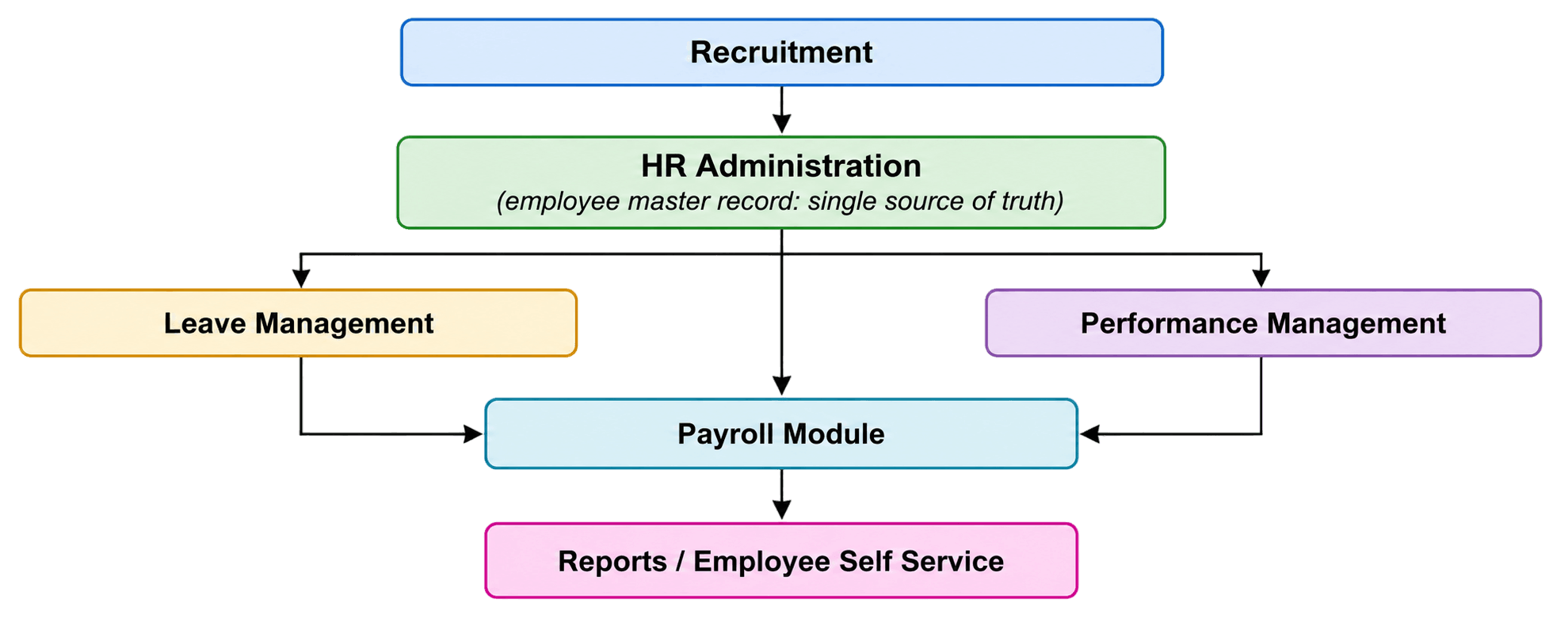
A candidate approved through Recruitment becomes an employee record in HR Administration. That record then governs what Leave Management applies in terms of entitlement, what Performance Management uses for reporting lines and review hierarchies, and what Payroll reads to calculate salary. Reports and Employee Self Service sit at the output end, drawing from the updated state of all modules rather than maintaining their own separate data.
This architecture means that a gap or error at any point in the chain propagates downstream. An incomplete employee record in HR Administration will affect leave calculations, payroll accuracy, and the data visible in self-service. This is why the HR Administration module is treated as foundational: it is the point where data integrity either holds or breaks.
Summary
Sage 300 People is organised into modules covering HR administration, payroll, leave management, recruitment, and performance management. Each module covers a distinct operational area, but they share a common employee record, which is what keeps data consistent across the system. The HR administration module is the foundation; everything else builds on top of it.
Frequently Asked Questions
What modules are included in Sage 300 People?
HR administration, payroll, leave management, recruitment, and performance management.
Which module manages payroll in Sage 300 People?
The payroll module handles salary processing, but it draws data from the HR administration and leave modules to run accurately.
Can Sage 300 People modules be purchased separately?
This depends on the licensing arrangement with the implementation partner. The HR administration module is foundational and generally required for other modules to function correctly.
What is the difference between a module and a feature in Sage 300 People?
A module is a structural area of the system with its own access controls and configuration. A feature is a specific capability within a module, such as WPS file generation within the payroll module.
Does Sage 300 People allow different access levels per module?
Yes, permissions can be configured so different roles access only the modules relevant to their function.